
THE SEWING MACHINE
a short story by Harold Rogers


Greetings everybody,
Today I am excited to bring you a special edition of The Sewing Machine Newsletter featuring a short story by Harold Rogers.
I started following Harold after hearing him on a podcast where he spoke about books and writing with a borderline psychotic passion that I greatly admired. He is the author of Tropicália, an excellent novel I read in just a few days. He also writes my favorite non-sewing Substack, THE ANNALS OF HAROLD.
I reached out to Harold and asked him to write something I could share with my audience of sewing machine enthusiasts. He obliged with a 3,000 word short story, THE SEWING MACHINE, accompanied by an audio recording of him reading the story aloud.
I enjoyed it very much. I think you will, too.
—Cale Schoenberg
THE SEWING MACHINE
by Harold Rogers
— 1
THERE WAS A boundary-setting problem, and the thing about boundary-setting problems: they have a tendency to multiply like sewer rats; or, to be more exact. . . — the other unrelated problem in this story ends up being the sullifying journey language takes thru molten acres of conscience before breaching the scorched crust of decision, splatting on the irrevocable shore of action, crippled: so let’s at least try to make our metaphors precise, — these boundary-setting problems don’t multiply: they infect like a troupe of leeches; but instead of ditching their bloodspent victim once they skip town, they hitch its carcass to the wagon, dragging the putrid chain of these husk people.
To get to the point: the problem was the sewing machine.
Lately, on the way home, as she turned off 3rd Ave onto 47th Street, Hera felt dread. She knew, soon as she opened the door: her mother, hunched & slack at the kitchen table, sinking into her wine-morass,
“Filha. . .”
Hera would take her seat across from her, dutifully; to endure an interminable pelting with the put-together nonchalance of a seasoned therapist. Sure, it was a prudent decision, financially: living with her parents at 25; but costs were starting to emerge in different ways.
As Hera’s career & social life blossomed, accentuating the numinous glow of her impervious youth; her mother, Celma, spent the preponderance of her time at a tedious job that underpaid her experience to hoard acorns for a retirement that loomed dull & pleasureless; her friendships were dwindling, and her former best friend: her husband, João, seemed everyday more like a pesky irremovable wart than a reciprocal partner. Lately Celma had been making snide comments about how Hera always seemed to have fun plans, how she could hardly believe her own daughter made more money than her. Celma had completely stopped asking Hera how she was.
Last week Hera invited her out to dinner, and as they walked around the city, her mother was a busted fire hydrant gushing complaints for four hours nonstop!
The reasonably fortunate & healthy have a forcefield around them in their 20s, where the exigencies of life-horror, time, & bitterness, though perceivable on the horizon, are disallowed by that diligent bouncer: hope. Celma’s daily, earbeatings were puncturing little holes in Hera’s bubble; despair was starting to seep in.
Pedro always annoyingly told her : she shouldn’t make her mom’s problems her problems. There had to be a boundary. Easy for him to say. He wasn’t close with his parents. They lived a million bumfuck miles away. He had siblings to take some of the burden. And he was a son! It’s so easy to be a son!
Plus he didn’t realize how her mother was a planet of doom; she would suck Hera right in, make her a vestigial moon,
“. . . I can’t believe my sister would do this to me. I can’t sleep. I can’t eat. I don’t know what to do. I didn’t think life would be like this Hera. . . and I heard you talking to Leya the other night, you said your dream is to get married at grandma’s house right? It’s not going to happen. That’s your Aunt’s house now and she hates us.”
“But mãe, she doesn’t hate me, this isn’t really my beef, like —”
“Yes it is, Hera. It is.”
The death of Hera’s grandmother unmoored Celma. Her memories of Belo Horizonte, the stability of the world she abandoned for the United States, were bundled together like sticks in a nest; her mother was a perpetual mama bird sitting there waiting for Celma to return to the magic ease of her early life. A life she traded for the wondrous potential of New York City and love, — back then João felt like the most permanent, fulfilling substance in the whole world: if she was feeling empty, regretful, inhaling him would resolidify her; like every aspect of her life, her marriage was a late-November tree, the leaves were falling off faster than she could account for, and she was trembling.
But now her mother was dead, the mythic nest irremediably annihilated, every Celma she could’ve been nailed shut in contingency’s coffin: her life was cemented. Hera was the only thing she had. . . and she worried it wasn’t enough.
Especially since her middle sister, Aziza, inherited everything.
Celma, and her other sister, Catarina, were surprised their mother willed everything to Aziza. The house made sense: Aziza was the only one who could really afford the upkeep. But the other sisters assumed Aziza would fairly distribute paintings & jewelry, so that the women could have keepsakes of their mother. Aziza didn’t part with a single possession. It wasn’t such a surprise; Aziza was insecure about her place in the family; Catarina was the oldest and she never lived more than a few miles away; Celma was the youngest, the prettiest, she lived in New York since she was 22 (and she had their mother’s name!); Aziza felt like she never had her mother’s complete doting favor (which to be fair, her mother: icy & imperial, never gave to anyone), — and she was greedy. Nothing meant more to her than stuff.
There was only one thing Celma truly wanted: her grandmother, Jamilla’s sewing machine.
Celma was Jamilla’s favorite; when she was a kid, she was her grandmother’s shadow, watching her work at the machine. Before she died, Jamilla promised the machine to Celma. It was one of the things she left behind when she moved because space was sacred in New York City. Plus, Celma couldn’t sew. But it already belonged to her! After her mother died, Celma decided she was going to take the machine and finally learn how to sew, — even teach Hera! But when she trepidatiously asked Aziza for it, her sister went batshit. Aziza insisted every last thing in the house belonged to her and you’d have to pry the machine from her cold dead hands.
Now the sisters weren’t speaking; their grandmother’s sewing machine was collecting dust in the attic.
“I don’t know what to do Hera. . .”
“Mãe, you just gotta forget about it, please! You know what Aunt Aziza’s like.”
“I can’t forget about it. . .”
Hera felt helpless; this impasse was going to hack away at both of them like a demented sculptor on a block of marble: soon they’d be a pile of wrecked irreparable debris.
— 2
PEDRO WAS SICK of hearing about it too. His mother was a seamstress, yet he’d never heard so much about a damn sewing machine in his entire life.
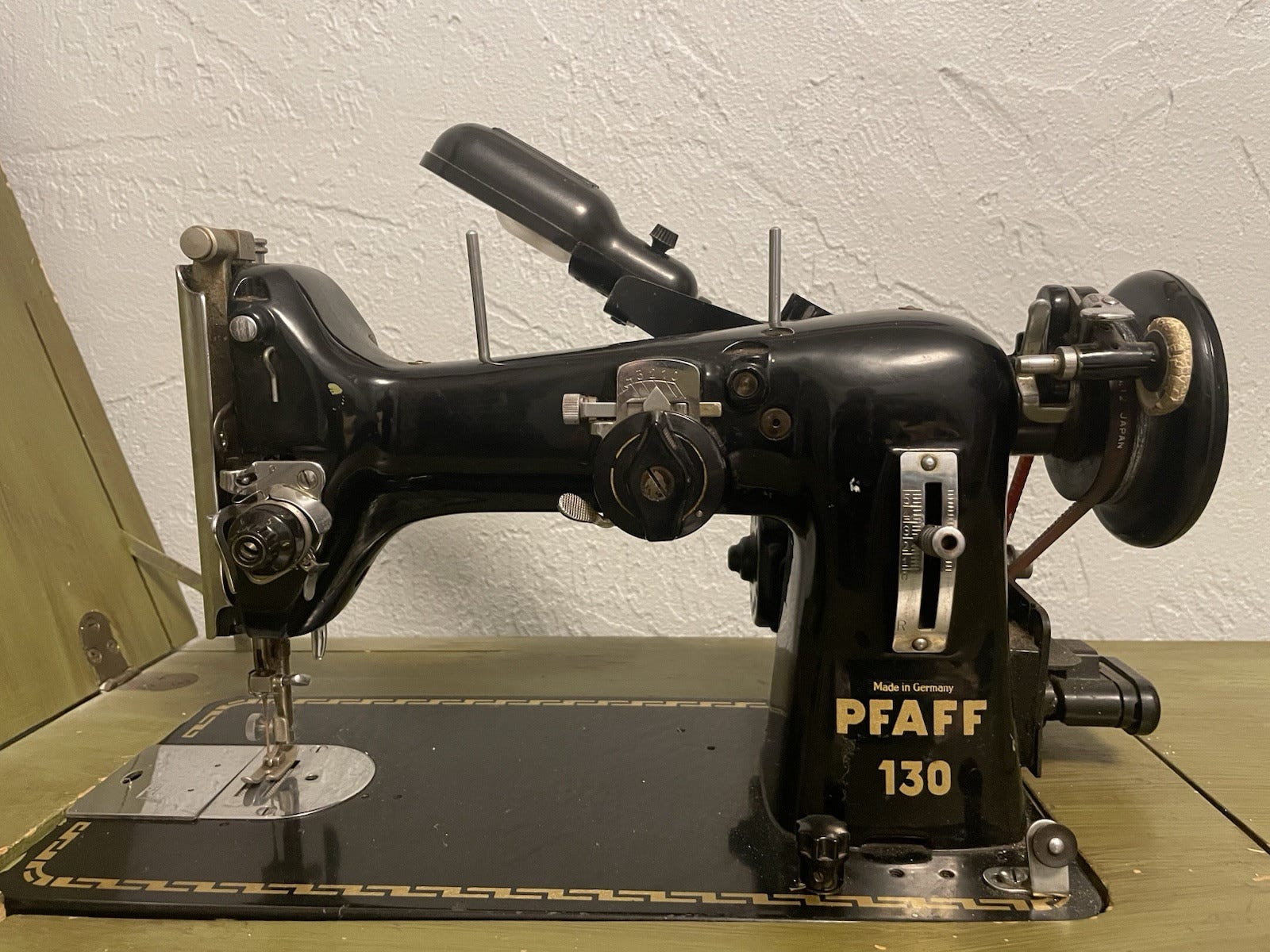
The machine was a Pfaff 130: sleek, black, excellent. Hera’s great grandmother Jamilla’s prized possession; she bought it in 1952 and used it to become the premier seamstress for Upper Class women in Belo Horizonte. A spark of upward mobility for the whole family. Hera told him the story when he told her what his mom did. He said his mom had the exact same sewing machine (he didn’t know if that was true but it sounded familiar)! It was one of those early romance coincidences that make the love-connection seem inevitable.
But now all Hera could talk about is how this machine problem was ruining her mother’s life. He told her: you can’t let her despair ruin your life. Your life is more important than anyone else’s. If your mother’s drowning, you can’t let her grab on and drown you too.
Maybe Pedro was selfish, but he insisted on maintaining the integrity of his own happiness; he understood Hera was an only child, she lived at home: there was an ethical onus on her he never felt in his own family (if his mother was bitching, he’d cut the call short).
How far did Celma’s complaints reasonably extend? Because when he went over to her apartment for his twice weekly dinner with her family, Celma was dumping on him; his attention was being compromised by a beef that frankly, had nothing to do with him.
A wake up call: he was at the bar drinking with Ethan; Ethan said,
“Dude enough about this fucking sewing machine.”
This sewing machine was consumption; everyone in Hera’s vicinity was developing a tubercular, emaciating cough. The worst part: nobody was gonna do nothing! Hera & Celma were knee-deep in the bog of inaction, woe-is-me-ing out the wazoo. Pedro was a man. When he had a problem, he solved it.
He had an idea.
It was clear to him Celma was right and Aziza was being a bitch. He couldn’t believe how far family relations had broken down; a month ago he was staying in Belo Horizonte at Aziza’s house, and everything, despite some classic sister-tension, was hunkydory. Now they weren’t speaking? Over a thing? Pedro understood easily how someone could destroy their own life thru lust or pride or wrath, but greed? It ain’t even like we still believe, like the Pharaohs: that you’d take the stuff with you hereafter. When has stuff ever made anyone happy? You’ll be sitting on your pile of coins, grimmer, weaker, lonelier, until it’s croaksville and you’re in the dark abyss: penniless once more.
Pedro was a reductive thinker. He didn’t understand : it was less a stuff problem than a death problem. Greed is a reaction to finitude. You hoard & pile because it feels like permanence, — control. Aziza couldn’t possibly give up a single item from the house. Her mother bequeathing everything to her and not Celma vindicated a whole childhood of emotional privation. (Nevermind that Aziza actually rewrote the whole will and had her mother sign it at the tail-end of her lucidity; a crime Celma suspected: but who wants to endure the torpor of the law?) If Aziza gave up the sewing machine, she might also have to face and reckon with the hard knot of hurt she built her whole self around. Show me a person who ain’t a train! These tracks are hard to change.
Nobody ever accused Pedro of being emotionally capacious. In his mind: machine gone, problem gone. So he called his cousin Renato. You’re going to think it’s a horrible idea once you hear about Renato. He was 23, he lived in Rio das Ostras; he had a decent job at the mayor’s office, but he was fired for stealing, again. He was fired from every job for stealing. Pedro didn’t know if Renato was afflicted by a nagging kleptomania, but thieving was the only constant in his life. Stealing and smoking weed; Renato loved to smoke weed.
He & Pedro had been friends growing up; Pedro was like his big brother. Now that his uncle was dead, Pedro felt bad for Renato: the dude was a total loser, reeked of loserdom to everyone around him, but he had metaphorical clothespins pinching his nose shut: he’d never smell himself and shape up. Here was a big difference between Pedro & Hera: if Renato was her cousin, she’d probably feel duty-bound to make a big effort to change his life, but Pedro lets people hang themselves with their own rope: their cousinly friendship was almost completely substituted by the sending of Instagram reels, occasionally a WhatsApp if Vasco won. Pedro did send him a couple hundred bucks every few months, — if he was flush with cash.
As lazy as Renato was, he was a good burglar.
He called Renato: “fala aí primo, you wanna make some money?”
It was tricky setting up a robbery/not-robbery. Pedro knew there was an easy way to get into the house: the lock was broken on the attic window. If you climbed up to the roof, you could slide right in. And the sewing machine was right there! He told Renato that was the main target. He said to take a few more things so it wouldn’t look suspicious, and to get out without hurting anybody! If he succeeded, Pedro was gonna give him 500 USD.
“In Beagá? That’s like a nine hour drive. . . but OK cara, I got a contatinho in Juiz de Fora I’ll stay with her, you know eat that pussy up, you know how I get it moleque.”
“Ta bom, Renato.”
“Trust me primo, I got this shit. Tranquilo!”
Renato said he would do the job in exactly one week.
— 3
THERE WAS A problem: Pedro didn’t hear from Renato when he was supposed to. He hoped his cousin had gotten too high and chickened out.
But on Tuesday morning, the day after the scheduled heist, Pedro got a call from Hera.
“Oh my god Pedro. . .”
“What? Is everything OK? You sound worried.”
“Someone broke into my Aunt’s house!”
“Is she OK!?”
“Just come over, I’ll tell you everything.”
Pedro cancelled his 10AM client at the gym. Hopped on the 4 train uptown to Grand Central.
Hera opened the door; she looked frazzled.
“What happened, you gotta tell me everything.”
“Oh my god. . . well Aunt Aziza and Uncle Marcos were sleeping and they heard a bunch of noise in the attic, and you know how paranoid Uncle Marcos is, he immediately grabs his gun — ”
“He has a gun?”
“He has a bunch of guns, you know that? I feel like he was talking your ear off about it.”
“Oh yeah, yeah, anyway.”
“They just assumed it was the cats that get in there sometimes. But as they’re walking up the stairs, a literal fucking guy in a ski mask comes running down, bouncing his flashlight around, carrying something! Aunt Aziza said she screamed and the guy screamed and Uncle Marcos just starts shooting!”
“Jesus Christ! Did he hit anyone?!”
“No it was dark, he couldn’t see, he was just shooting at the wall. But the guy takes off running, trying to find a way to get out of the house and Marcos and Aziza start running after him, eventually he busts through the screen door to the back patio, he broke the whole thing! and he must’ve been cut because he was leaving a trail of blood, and Marcos is trying to shoot him this whole time, and then they see him toss whatever he took over the fence and he hops up over after it and he’s gone. Uncle Marcos is still trying to follow him and he’s running, but there’s the pool in the yard, Pedro! You remember.”
“Obviously.”
“Right! But it had just been drained and he was so focused on going after the guy that he didn’t realize it, and he fell right in the empty pool.”
“Holy shit! Is he OK?! You can die like that!”
“I know! He broke his leg. Everything else is fine, but his leg was broken pretty bad.”
“I’m just glad it’s nothing worse. . .”
“But get this. Guess what was the only thing the guy took.”
“The sewing machine?”
“. . . yeah. . . how’d you know?”
“I mean that’s just absolutely perfect, of course it was the sewing machine.”
“It’s like too perfect! Why would he only take that?”
“Well. . .”
“Why are you laughing so hard?”
“This is a hilarious situation, don’t you think?”
“No! They could’ve died! They’re like traumatized. There’s bulletholes in the wall! My Uncle’s leg is broken! I don’t think that’s so funny.”
“Wait how do you know this anyway? Did Aziza call your mom?”
“That’s the thing too! They were on the phone together like all night. She told me this morning. My mom was like literally glowing this morning, I haven’t seen her like that in forever. My Aunt apologized to her! APOLOGIZED! She’s never apologized to my mom for anything in her whole life. I guess she felt like this was a cosmic judgment from God for being such a bitch over the whole sewing machine. She even said if it was still around, she would give it to my mom. She said she never wants anything to get in the way of their friendship again. My mom was like literally crying tears of joy telling me this.”
“That’s amazing! This is the best thing that could’ve happened!”
“Why the hell are you laughing so hard Pedro?!”
“Can I tell you something? You can’t get mad.”
“I already know I’m gonna be pissed. . .”
“This robbery’s, uh, not a coincidence. . .”
“What do you mean?”
“I got Renato to do it.”
“Excuse me.”
“Renato, my cousin?”
“The dumbfuck pothead? You had him break into my fucking grandma’s house and rob my Aunt and Uncle. Is that what you’re really telling me right now?”
“. . . well yeah.”
“ARE YOU INSANE PEDRO?!”
“I just wanted to help! Nobody was doing anything! I was sick of hearing about this machine all the time!”
“It wasn’t your problem to solve! It had nothing to do with you!”
“Didn’t have anything to do with me?! Your mom was talking my ear off about it! You were talking my ear off about it! I was having dreams about a goddamn Pfaff 130!”
“SHE WAS TALKING YOUR EAR OFF?! HUH?! MY MOM WAS ANNOYING YOU!!! ARE YOU FUCKING JOKING ME! You’re such an asshole Pedro!”
“An asshole!? I fixed this whole situation! Your mom and your Aunt are talking again! Your mom is happy!”
“It could’ve gone horribly wrong.”
“Yeah, but it didn’t.”
“Get out of here, will you. I don’t wanna talk to you right now.”
“Hera, I really think I deserve a thank you.”
“Here’s what you get.”
“Don’t flip me off. Your finger looks too funny like that.”
“Fuck. YOU.”
“See I know you’re just messing around now.”
“LEAVE!”
“Really?”
“YES!”
“OK. But I know you’re gonna apologize to me later. I love you baby.”
“DON’T TOUCH ME!”
Pedro should’ve kept his mouth shut, not told Hera anything, but he wanted kudos for his swashbuckling decision-making: the moment called for it, and he acted! it had gone perfectly; well, nobody was dead at least. And there was no telling how long peace would last; but Pedro was right insofar as: that night, Hera called him to apologize and invited him over for dinner. He and her parents sat in perfect felicitous conviviality; Pedro listened to the heist story from Celma like he’d never heard it before, — Hera prudently didn’t tell her about Pedro’s involvement, — and after that, nobody said a word about the sewing machine.
On his way home that night, he finally heard from Renato,
“porra mermão you almost got me killed! hit me with that Pix $$$”

 | A guest post by
|
OMG that was enjoyable to read.
Superb! I giggled a lot. 😁